Identified Fission Product Isotopes on Filter Papers and Aircraft Surfaces
The specific isotopes recoverable from tip-tank filter papers and aircraft skin were a direct function of elapsed time since detonation, shot yield, device type (fission vs. thermonuclear), and altitude of cloud penetration. Based on LASL/UCRL radiochemical program documentation cited in SWEH-2-0034 and the DNA nuclear test personnel review series, the principal isotopic species are reconstructed as follows :
- Short-lived fission products (dominant on early-penetration aircraft, T+1–4 hrs):
- Barium-140 / Lanthanum-140 (Ba-140/La-140): Half-life 12.8 days / 1.68 days. Among the highest specific activity species on early filters. Ba-140 decay to La-140 produced significant beta/gamma fields on filter papers within hours. A primary “fresh fallout” indicator and a key weapon-yield diagnostic isotope at LASL.
- Iodine-131 (I-131): Half-life 8.05 days. Volatile fission product, partially in gas phase. Collected on carbon-impregnated filter paper and in the double-squeegee gas samplers installed on F-84G aircraft from CASTLE onwards. A principal human-dose concern for ground crews removing hot filters.
- Zirconium-95 / Niobium-95 (Zr-95/Nb-95): Half-life 64.0 / 35.0 days. Major particulate fission product; constituted a large fraction of the total gamma activity on filter papers at the T+24 hr mark. Listed in UNSCEAR and LASL program records as a dominant contributor to cloud sample activity in the 1–12 week window.
- Ruthenium-103 / Rhodium-103m (Ru-103): Half-life 39.4 days. Significant contributor to beta contamination on aircraft skin and filter assemblies, especially in the tip-tank filter holders where oxidative deposition was noted .
- Cerium-144 / Praseodymium-144 (Ce-144/Pr-144): Half-life 284.4 days / 17.3 min. High-energy beta emitter; among the most biologically significant longer-lived species found on filters. A key LASL diagnostic isotope for fractionation studies .
- Long-lived fission products (persistent residuals on aircraft, T+days–weeks):
- Cesium-137 (Cs-137): Half-life 30.17 years. Volatile, partially gaseous during explosion; deposited on surfaces in ionic form. Became the principal long-term gamma source on aircraft not fully decontaminated. The CDC/NIOSH and UNSCEAR analyses identify Cs-137 as the dominant dose contributor from contaminated aircraft surfaces at T+weeks .
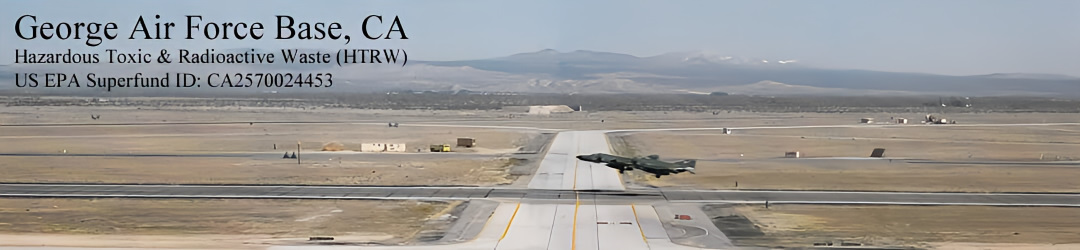
- Strontium-90 / Yttrium-90 (Sr-90/Y-90): Half-life 28.8 years / 2.67 days. Refractory; concentrated in the stem and lower cloud. Found in soil and water scrubber effluent at decontamination strips. Sr-90 penetrated wax and paint coatings via ionic migration and was documented in decontamination wash water at Indian Springs AFB and George AFB decon strips .
- Strontium-89 (Sr-89): Half-life 50.5 days. Higher specific activity than Sr-90 at early post-shot times; a secondary yield-diagnostic isotope used alongside Ba-140 at LASL .
- Special nuclear material (SNM) residuals on aircraft:
- Plutonium-239/240 (Pu-239/240): Alpha emitter. Present in cloud samples from implosion-type fission devices where not all Pu underwent fission (“unreacted Pu”). Detected in soil survey data around NTS tracking aircraft landing areas and documented by the Timbisha Shoshone tribal lands soil survey as a Pu-239/240 contamination source attributable to atmospheric testing . Alpha contamination on interior filter assemblies required tong handling and lead pig containment at all stages.
- Tritium (H-3): Half-life 12.33 years. Present in thermonuclear cloud samples from CASTLE, REDWING, HARDTACK, and PLUMBBOB thermonuclear shots. Tritiated water vapor penetrated aircraft pressurization seals. Tritium from these samples was identified in LASL laboratory logs and cited in the ACHRE/DOE Roadmap documentation as a skin-absorption and inhalation hazard for filter-removal crews.
- Uranium fission fragments: In boosted/thermonuclear devices with U-238 tampers, fast-neutron fission of the tamper produced additional fission products (beyond those from the Pu/U-235 primary) enriched in the heavier actinide chain. This contributed to anomalously high Ce-144, Cs-137, and Eu-155 yields relative to theoretical “clean” fission device calculations — a key fractionation diagnostic at LASL.
Aircraft Decontamination: Methods and Residuals
The standard decontamination sequence described across SWEH-2-0034 and the DNA PLUMBBOB/TEAPOT series was:
- Overnight “cool-down”: Aircraft left on remote hardstand (e.g., east end of Indian Springs flight line or old Japanese parking area on Kwajalein) to allow short-lived isotope decay. The primary benefit was the reduction in I-131, Ba-140, and Nb-95 activity during the first 12–24 hours.
- Chemical wash: “Gunk” (a petroleum-based degreasing compound) followed by high-pressure water rinse. For RANGER (1951), 1,200–1,600 gallons of water and 75–80 gallons of solvent per aircraft were used. This removed loosely adhered particulates but did not address ionic Sr-90 or Cs-137 that had diffused into the paint and aluminum oxide layers.
- Acid brightener polish: Introduced during UPSHOT/KNOTHOLE (1953), polishing with acid brightener reduced surface contamination from approximately 50% to ~17% of the total measured activity by removing the oxidized surface layer containing adsorbed fission products. This was the single most effective decontamination innovation for reusable sampler aircraft.
- Lead shielding installation: From UPSHOT/KNOTHOLE onward, cockpit interiors were lined with 1/32-inch lead sheet, and pilots wore lead-fiberglass vests (six pounds). The vest reduced cockpit dose by 17% (measured NANCY Shot) to 40% (measured CASTLE).
- Residual contamination protocol: Aircraft not brought to background-equivalent levels were restricted to the remote decontamination strip. The TEAPOT survey confirmed that, even after multiple washes, the 17 aircraft surveyed retained 1–14R contact readings — attributable primarily to Cs-137, Sr-90, and Ce-144 in the surface oxide layer that acid brightener alone could not fully remove.
Isotope-Specific Contamination by Test Series
| Test Series | Primary Aircraft | Dominant Isotopes on Filters / Aircraft | Peak Surface Reading | Notes |
|---|---|---|---|---|
| RANGER (1951) | WB-29 | I-131, Ba-140, Zr-95 | Below 1R (low yield shots) | First manned sampling; minimal contamination per Col. Cody’s report |
| BUSTER/JANGLE (1951) | B-29, T-33 | I-131, Ba-140, Ru-103, Zr-95 | Not published; T-33 samples “six times stronger” than B-29 | Beta burns on filter-handling personnel; tong protocol introduced |
| TUMBLER/SNAPPER (1952) | T-33, F-84G, B-29 | I-131, Zr-95, Cs-137, Ba-140 | Not individually published | Pressurized B-29 cabin experiment; minor crew skin/clothing contamination |
| IVY/MIKE (1952) | F-84G, B-36 (sniffer) | I-131, Cs-137, Sr-90, Ce-144, Pu-239, Tritium | “Pegged” instruments (above scale) in cloud core | Thermonuclear MIKE cloud; LASL declared samples “best taken from any detonation” |
| UPSHOT/KNOTHOLE (1953) | F-84G | I-131, Ba-140, Zr-95, Ru-103, Cs-137 | ~1–3R estimated (acid bright. reduced to 17%) | Acid brightener protocol introduced; lead cockpit lining from RAY Shot |
| CASTLE (1954) | F-84G, B-36 “Featherweight” | Cs-137, Sr-90, Ce-144, Eu-155, Pu-239, Tritium, Zr-95 | Not published; “adequate to excellent” samples | B-36 at 55,000 ft; lead vests cut dose 40%; BRAVO samples “best ever taken” |
| TEAPOT (1955) | F-84G, B-57A | I-131, Cs-137, Sr-90, Ba-140, Zr-95, Ru-103 | 1.0 – 14.0R (17 aircraft surveyed) | Most comprehensive surface contamination survey; AFSWC survey group |
| REDWING (1956) | B-57B, F-84G | Cs-137, Ce-144, Pu-239, Tritium, Sr-90, Eu-155 | Not individually published | First B-57B operational use; RAAF East Sale staging for transoceanic echelon |
| PLUMBBOB (1957) | F-89D, B-57B | Cs-137, Ba-140, I-131, Sr-90, Ru-103, Zr-95 | 3.55R (F-89D external); 2.44R (observer cockpit) | ANG units decontaminated at George AFB; 4926th/4950th aircraft peak: 116 aircraft |
| HARDTACK I & II (1958) | B-57B, F-101 | Cs-137, Sr-90, Ce-144, Ba-140, Pu-239, Tritium | Not individually published | High-altitude TEAK/ORANGE shots; Johnston Island staging; some aircraft retained residual contamination into 1960s |
| DOMINIC I (1962) | B-57B, WB-50 | Cs-137, Sr-90, Ce-144, I-131, Pu-239, Tritium | Not individually published | Last atmospheric series; 4926th transferred to MATS/12111th TS; samples transported to LASL via Kirtland courier chain |
Be the first to comment