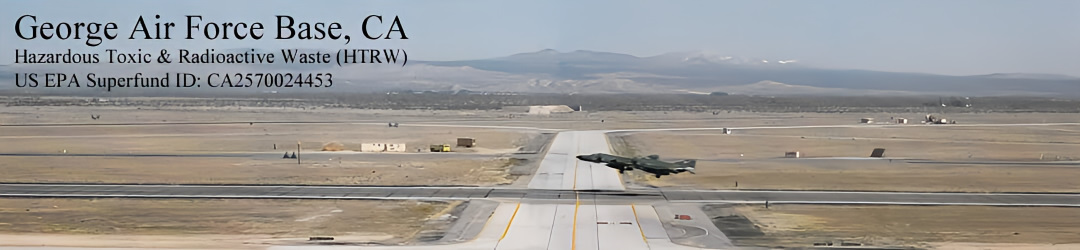

The U.S. Air Force and Department of Defense (DoD) transferred property at the former George Air Force Base (AFB), a closed Superfund site, through quitclaim deeds for Parcel B, which includes a “HOT wash rack” or radiological decontamination center. Amazon and Goodyear have since developed warehouses on this site. The alleged failure to disclose known or potential contamination, including degreasers such as trichloroethylene (TCE), solvents, and radioactive isotopes from decontamination activities associated with atmospheric nuclear weapons testing, could violate several federal and state laws. These violations arise from transparency requirements for federal property transfers, especially at contaminated sites.
Note: Radioactive materials from defense programs (regulated under the Atomic Energy Act) are often excluded from standard “hazardous substance” definitions under CERCLA, but mixed wastes (radioactive combined with chemical hazards like solvents) or non-radioactive contaminants still need to be disclosed. If the Air Force knew about contamination but did not report it, this could be a violation. Historical records show George AFB hosted radiological decontamination centers in the 1950s-1960s, where aircraft exposed to nuclear tests were washed down, potentially causing soil and groundwater contamination in the west-central area (now overlapping with warehouse sites). Cleanup efforts since the 1980s have focused on solvents and jet fuel, but radiological concerns remain unaddressed and not fully disclosed to the public.
Part I: Laws Potentially Violated
A. Federal Environmental Law — The Core Statutory Violations
1. CERCLA § 120(h)(3) — The Primary Violation. This is the most directly applicable statute. CERCLA § 120(h)(3) requires that in the case of any real property owned by the United States on which any hazardous substance was stored for one year or more, known to have been released, or disposed of, each deed entered into for the transfer of such property by the United States to any other person or entity shall contain: a notice of the type and quantity of such hazardous substances; notice of the time at which such storage, release, or disposal took place; and a description of the remedial action taken, if any. Noaa
Additionally, CERCLA § 120(h)(3)(A) requires that a federal agency transferring real property to a nonfederal entity include a covenant in the deed of transfer warranting that all remedial action necessary to protect human health and the environment has been taken prior to the date of transfer with respect to any hazardous substances remaining on the property. US EPA
The fission byproducts, degreasers, and solvents from the HOT wash rack on Parcel B constitute hazardous substances that were stored, released, and disposed of on that property. Their omission from both the 2004 and 2007 Quitclaim Deeds is a facially apparent violation of these mandatory disclosure and covenant requirements.
2. CERCLA § 103 — Knowing Failure to Notify / Falsification of Records Regarding criminal authority, individual employees of Federal agencies who commit criminal violations of CERCLA may be subject to sanctions. Criminal fines may be imposed either under CERCLA § 103 or 18 U.S.C. § 3571, the Alternative Fines Act. Enforcement of criminal violations is authorized under CERCLA § 103 for knowing violations and the falsification or destruction of records. US EPA
The documented pattern — including the Air Force denying the existence of the decontamination centers since 1985, failing to include them in the CERCLA Administrative Record, and omitting them from deed disclosures — suggests this rises above negligence to a knowing violation, which triggers criminal liability under § 103.
3. CERCLA § 120(h)(3)(B) — “Operating Properly and Successfully” Certification CERCLA § 120(h)(3)(B) requires, under certain circumstances, that a federal agency demonstrate to the EPA Administrator that a remedy is “operating properly and successfully” before the federal agency can provide the “all remedial action has been taken” covenant. US EPA If the Air Force certified in the deed covenant that all remedial action had been taken on Parcel B while knowing the HOT wash rack contamination had never been assessed or remediated, this certification itself constitutes a false statement to a federal regulator.
B. Federal Criminal Statutes
4. 18 U.S.C. § 1001 — False Statements to the Federal Government If Air Force officials signed deed documents certifying completeness of hazardous substance disclosures while knowing of the HOT wash rack contamination, each such certification is a potentially false material statement to a federal agency. This is a felony carrying up to 5 years imprisonment per count.
5. 18 U.S.C. § 1519 — Destruction, Alteration, or Falsification of Records The documented withholding of Dr. Sabol’s 1979 radiological survey from the CERCLA Administrative Record, and the denial of FOIA requests for those records, may constitute obstruction of a federal investigation or proceeding. This statute carries up to 20 years imprisonment.
6. 18 U.S.C. § 371 — Conspiracy Against the United States If multiple Air Force and DoD officials coordinated the concealment of HOT wash rack contamination from regulators, transferees, and the public, a conspiracy charge becomes viable.
C. Atomic Energy Act and NRC Regulations
7. AEA / NRC Regulations — Unlicensed Possession and Failure to Remediate Radioactive Material California law addresses emergency response, containment of radioactive contamination of the environment, and transportation of radioactive materials under California Health and Safety Code sections 114650 through 114835. CA Because California is an NRC Agreement State, in 1962, California ratified and approved an agreement with the Atomic Energy Commission by which the federal agency discontinued its regulatory authority over certain radioactive materials, making California an “Agreement State” that must maintain a statewide program adequate to protect public health and compatible with NRC standards. CA
This means fission byproducts transferred to private parties via a flawed deed may now exist on privately owned land without any NRC or state radioactive materials license — a potentially independent violation by Amazon and Goodyear as current property holders, even if they are innocent parties.
D. Occupational Safety and Health — Workers at Amazon and Goodyear Warehouses
This is a category of ongoing, present-day violations, not merely historical ones.
8. OSHA 29 CFR § 1910.1096 — Ionizing Radiation Standard Every employer shall make such surveys as may be necessary to comply with the ionizing radiation provisions. Survey means an evaluation of the radiation hazards incident to the production, use, release, disposal, or presence of radioactive materials or other sources of radiation under a specific set of conditions. Occupational Safety and Health Administration
Amazon and Goodyear — as employers of warehouse workers on potentially contaminated soil — have an affirmative duty to survey for ionizing radiation hazards. If they have not done so, they are in violation of OSHA’s ionizing radiation standard. If the Air Force withheld contamination information from the transferee chain of title, making such surveys unlikely to occur, the Air Force’s non-disclosure created the conditions for ongoing worker exposure.
9. Cal/OSHA Title 8, §§ 5075–5085 — Radiation and Radioactivity Cal/OSHA’s Radiation and Radioactivity regulations require that individuals who are working with radiation receive information regarding radiation and radioactivity. USFCA Workers in Amazon and Goodyear facilities built over the HOT wash rack site have received no such information because the contamination was not disclosed.
E. California State Law
10. California Health and Safety Code § 13147 In cases of gross negligence or intentional misconduct, criminal charges under California Health and Safety Code § 13147 can result in fines up to $100,000 and imprisonment, particularly if the violation leads to injury or environmental contamination. LegalClarity
11. California Civil Code § 1714 — Duty of Care / Failure to Warn California law allows individuals harmed by radiation exposure to seek damages through civil lawsuits under theories of negligence, strict liability, or failure to warn. Under Civil Code § 1714, individuals and entities have a duty to act with reasonable care to prevent harm. LegalClarity
12. California CERCLA Analog — Porter-Cologne Water Quality Control Act The Lahontan Regional Water Quality Control Board is a party to the original FFA and has independent enforcement jurisdiction over groundwater contamination. Solvent and radioactive isotope contamination from the HOT wash rack may have migrated into the aquifer, triggering Porter-Cologne Act enforcement obligations independent of federal CERCLA.
Part II: Who to Report This To
The following should each receive a formal, documented written complaint — not a phone call — so that a paper trail is established:
Federal Agencies
| Agency | Role | Contact |
|---|---|---|
| EPA Region 9, Federal Facilities Branch | Primary CERCLA § 120(h) enforcement authority; party to the George AFB FFA | epa.gov/fedfac — Superfund Federal Facilities, Region 9, San Francisco |
| EPA Criminal Investigation Division (CID) | Investigates criminal CERCLA violations under § 103, false statements | 1-888-372-7341 or online tip form at epa.gov/enforcement/report-environmental-violations |
| Department of Justice, Environment & Natural Resources Division | Civil and criminal prosecution of CERCLA violations | Through EPA referral or directly via U.S. Attorney, Central District of California |
| Nuclear Regulatory Commission (NRC) Region IV | Regulates radioactive materials in Agreement States; unauthorized possession of fission byproducts | nrc.gov or 1-800-695-7403 (24-hr Operations Center) |
| OSHA Region 9 | Ongoing worker safety violations at Amazon/Goodyear warehouses built over unremedieted radiological contamination | 1-800-321-OSHA; osha.gov complaint portal |
| U.S. Congress — House Armed Services Committee and Senate Environment & Public Works Committee | Oversight jurisdiction over both DoD environmental compliance and CERCLA enforcement | Direct written letters to your U.S. Senators and Representatives |
| Government Accountability Office (GAO) | Can investigate DoD non-compliance; Senator John Glenn previously requested a GAO investigation into DoD’s handling of radiologically contaminated bases | Request through a Congressional sponsor |
| DoD Inspector General | Investigates fraud, waste, and abuse within the Air Force and DoD, including false certifications in property transfers | dodig.mil — online hotline |
California State Agencies
| Agency | Role |
|---|---|
| California Department of Public Health — Radiologic Health Branch (RHB) | Primary state regulator for radioactive contamination and unlicensed radioactive material; as an NRC Agreement State agency, has independent enforcement authority. File a complaint at cdph.ca.gov |
| Lahontan Regional Water Quality Control Board | Party to the original FFA; independent enforcement authority over groundwater contamination from the HOT wash rack site |
| Cal/OSHA | Worker safety violations at Amazon and Goodyear warehouses; receives referrals from federal OSHA and can act independently under California labor law |
| California Attorney General’s Office | Can pursue state-law environmental and consumer protection claims against federal agencies for violations of ARARs incorporated into the FFA |
Congressional Notification — Specific Trigger
There is one additional avenue worth highlighting. CERCLA § 120(e)(5) requires the Air Force to submit annual reports to Congress on cleanup status at George AFB, including any stipulated penalties assessed. If those annual reports omitted any mention of the HOT wash rack contamination and the Parcel B transfer, those reports themselves may contain materially false statements submitted to Congress — a separate basis for congressional investigation.
Critical Practical Note
The statute of limitations for CERCLA civil claims is generally 3 years from the date of discovery of the violation. However, the discovery rule tolls this where contamination was actively concealed — which is precisely what is alleged here. Additionally, CERCLA § 113(g)(2) provides a 6-year limitations period for remedial actions. For criminal violations under 18 U.S.C. § 1519 (records falsification), the period is 5 years from the date of the act, but again, concealment can toll the clock.
The most time-sensitive priority is the worker safety dimension: Amazon and Goodyear employees working above an unassessed, undisclosed radiological contamination site today are potentially being exposed in real time. An OSHA complaint referencing both the specific location and the documented evidence of the HOT wash rack obligates OSHA to investigate, and that investigation is not subject to the same sovereign immunity obstacles that have historically shielded the Air Force from CERCLA noncompliance.
Be the first to comment