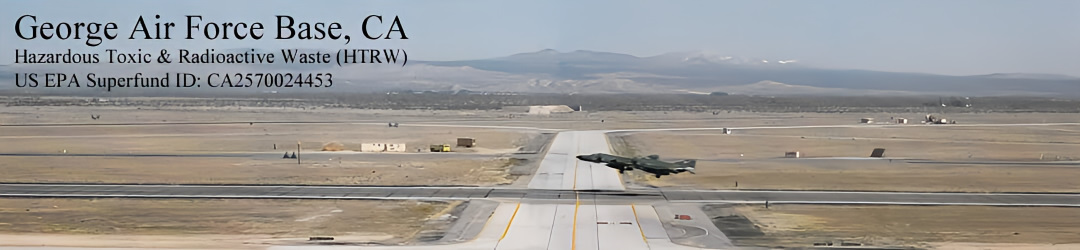

Aircraft involved in open-air nuclear testing at the Nevada Test Site (NTS) during the 1950s and 1960s that entered the nuclear clouds became heavily contaminated with short-lived isotopes, long-lived isotopes, Special Nuclear Material (SNM), and activated soil. Short-lived isotopes trapped in the oil and grease on returning aircraft posed an acute exposure risk to flight crews and ground personnel handling the aircraft upon its return, while long-lived isotopes and SNM presented chronic, long-term contamination concerns for airframes, equipment, and personnel repeatedly exposed across multiple test series. Radiological decontamination centers produced significant amounts of highly radioactive waste, including contaminated water, degreasers, solvents, and soil. As this liquid waste dried, it became radioactive dust that workers unknowingly carried home on their hair, skin, tools, and clothing. Once at home, this dust can become airborne, creating a serious secondary exposure risk for family members that can lead to cancers and other serious illnesses.
Open-air nuclear tower tests and near-surface bursts produced various types of radioactive materials through fission, neutron activation, and any unspent bomb material.
- Short-lived radionuclides are primarily short-lived fission products (e.g., iodine-131 with an 8-day half-life, xenon-135 with about a 9-hour half-life, and many others lasting from seconds to weeks or months). They cause intense initial radiation and fallout near the detonation site immediately after the blast but decay rapidly. In early post-detonation measurements — within hours to days — they represent most of the detected radioactivity.
- Long-lived radionuclides include long-lived fission products such as strontium-90 (half-life ~29 years), cesium-137 (~30 years), technetium-99 (~211,000 years), and iodine-129 (~15.7 million years). They persist in the environment over timescales ranging from decades to millions of years, contributing to long-term fallout, soil contamination, and global deposition, and become relatively more significant as shorter-lived isotopes decay.
- Special nuclear material (SNM) refers to unfissioned fissile material from the bomb core, such as plutonium-239 (from plutonium-based devices like Trinity’s “Gadget”) or highly enriched uranium. Not all fissile material undergoes fission; some disperses as particles or residues. SNM is strictly regulated because it can be used in weapons, and traces were measured in fallout and debris from tower tests.
- Activation products in soil: The intense neutron flux from the explosion activates—makes radioactive—elements in the surrounding soil, sand, or structures through neutron capture, creating various radioisotopes from silicon, aluminum, iron, sodium, and other elements in desert soil. This activated soil is drawn into the mushroom cloud, contributing to both local fallout and wider dispersal of contamination. It was among the radioactive materials carried back on returning aircraft, increasing the contamination load on airframes, equipment, and personnel.
Aircraft Decontamination: Methods and Residuals
The standard decontamination sequence described across SWEH-2-0034 and the DNA PLUMBBOB/TEAPOT series was:
- Overnight “cool-down”: Aircraft left on remote hardstand (e.g., east end of Indian Springs flight line or old Japanese parking area on Kwajalein) to allow short-lived isotope decay. The primary benefit was the reduction in I-131, Ba-140, and Nb-95 activity during the first 12–24 hours.
- Chemical wash: “Gunk” (a petroleum-based degreasing compound) followed by high-pressure water rinse. For RANGER (1951), 1,200–1,600 gallons of water and 75–80 gallons of solvent per aircraft were used. This removed loosely adhered particulates but did not address ionic Sr-90 or Cs-137 that had diffused into the paint and aluminum oxide layers.
- Acid brightener polish: Introduced during UPSHOT/KNOTHOLE (1953), polishing with acid brightener reduced surface contamination from approximately 50% to ~17% of the total measured activity by removing the oxidized surface layer containing adsorbed fission products. This was the single most effective decontamination innovation for reusable sampler aircraft.
- Lead shielding installation: From UPSHOT/KNOTHOLE onward, cockpit interiors were lined with 1/32-inch lead sheet, and pilots wore lead-fiberglass vests (six pounds). The vest reduced cockpit dose by 17% (measured NANCY Shot) to 40% (measured CASTLE).
- Residual contamination protocol: Aircraft not brought to background-equivalent levels were restricted to the remote decontamination strip. The TEAPOT survey confirmed that, even after multiple washes, the 17 aircraft surveyed retained 1–14R contact readings — attributable primarily to Cs-137, Sr-90, and Ce-144 in the surface oxide layer that acid brightener alone could not fully remove.
Isotope-Specific Contamination by Test Series
| Test Series | Primary Aircraft | Dominant Isotopes on Filters / Aircraft | Peak Surface Reading | Notes |
|---|---|---|---|---|
| RANGER (1951) | WB-29 | I-131, Ba-140, Zr-95 | Below 1R (low yield shots) | First manned sampling; minimal contamination per Col. Cody’s report |
| BUSTER/JANGLE (1951) | B-29, T-33 | I-131, Ba-140, Ru-103, Zr-95 | Not published; T-33 samples “six times stronger” than B-29 | Beta burns on filter-handling personnel; tong protocol introduced |
| TUMBLER/SNAPPER (1952) | T-33, F-84G, B-29 | I-131, Zr-95, Cs-137, Ba-140 | Not individually published | Pressurized B-29 cabin experiment; minor crew skin/clothing contamination |
| IVY/MIKE (1952) | F-84G, B-36 (sniffer) | I-131, Cs-137, Sr-90, Ce-144, Pu-239, Tritium | “Pegged” instruments (above scale) in cloud core | Thermonuclear MIKE cloud; LASL declared samples “best taken from any detonation” |
| UPSHOT/KNOTHOLE (1953) | F-84G | I-131, Ba-140, Zr-95, Ru-103, Cs-137 | ~1–3R estimated (acid bright. reduced to 17%) | Acid brightener protocol introduced; lead cockpit lining from RAY Shot |
| CASTLE (1954) | F-84G, B-36 “Featherweight” | Cs-137, Sr-90, Ce-144, Eu-155, Pu-239, Tritium, Zr-95 | Not published; “adequate to excellent” samples | B-36 at 55,000 ft; lead vests cut dose 40%; BRAVO samples “best ever taken” |
| TEAPOT (1955) | F-84G, B-57A | I-131, Cs-137, Sr-90, Ba-140, Zr-95, Ru-103 | 1.0 – 14.0R (17 aircraft surveyed) | Most comprehensive surface contamination survey; AFSWC survey group |
| REDWING (1956) | B-57B, F-84G | Cs-137, Ce-144, Pu-239, Tritium, Sr-90, Eu-155 | Not individually published | First B-57B operational use; RAAF East Sale staging for transoceanic echelon |
| PLUMBBOB (1957) | F-89D, B-57B | Cs-137, Ba-140, I-131, Sr-90, Ru-103, Zr-95 | 3.55R (F-89D external); 2.44R (observer cockpit) | ANG units decontaminated at George AFB; 4926th/4950th aircraft peak: 116 aircraft |
| HARDTACK I & II (1958) | B-57B, F-101 | Cs-137, Sr-90, Ce-144, Ba-140, Pu-239, Tritium | Not individually published | High-altitude TEAK/ORANGE shots; Johnston Island staging; some aircraft retained residual contamination into 1960s |
| DOMINIC I (1962) | B-57B, WB-50 | Cs-137, Sr-90, Ce-144, I-131, Pu-239, Tritium | Not individually published | Last atmospheric series; 4926th transferred to MATS/12111th TS; samples transported to LASL via Kirtland courier chain |
Be the first to comment