
EPA’s Missing Records: A Cover-Up or Oversight?
The US EPA has removed any references to radioactive materials or waste from its website for the following California Superfund sites: George Air Force Base, Lawrence Livermore National Laboratory, McClellan Air Force Base, Norton Air Force Base, Tracy Defense Depot, and El Toro Marine Corps Air Station.
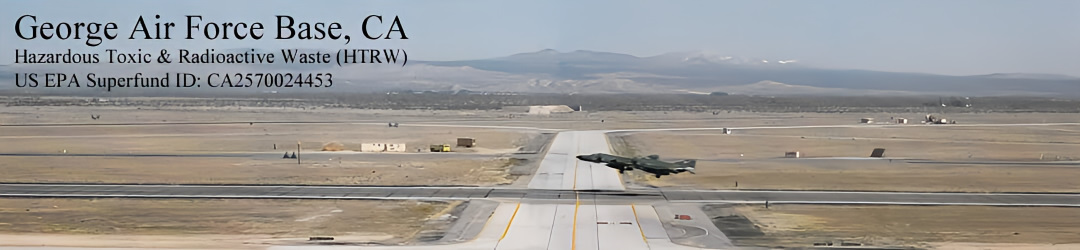
In 1991, the U.S. EPA documented radioactive waste as a health risk at George Air Force Base (AFB); however, by 2025, all references to this contamination had vanished from its website. While direct evidence of Department of Defense (DoD) pressure on the EPA is unavailable, a pattern of Air Force secrecy, as evidenced by withheld surveys, classified records, and non-compliance with DoD directives and CERCLA § 120(h), raises serious questions about why this critical information was withheld. Explore the evidence below to understand the potential cover-up and its impact on communities near George AFB.
The US EPA has removed all records of radioactive waste at George AFB from its website
 In 2025, the US EPA’s George Air Force Base “Contaminant List” does NOT mention radioactive material, waste, or isotopes.
Source: US EPA “George Air Force Base, Victorville, CA – List of Contaminants“
 In 1991, the US EPA acknowledged that groundwater and soil are contaminated with heavy metals, including lead, volatile organic compounds (VOCs), and radioactive waste.
Threats and Contaminants
Groundwater and soil are contaminated with heavy metals including lead, volatile organic compounds (VOCs), and radioactive wastes. Potential health risks exist through direct contact with or accidental ingestion of contaminated groundwater or soils.
Source: 1991-09-xx1991-09-xx EPA – National Priorities List Sites California and Hawaii – Full report (PDF – 5.33 MB)
1971: George AFB was notified by HQ USAF that its radioactive waste burial sites were to be accounted for, fenced off, and marked.
“2. For a number of years, land burial was authorized and Technical Order 00-110A-1, 25 May 1956, specified procedural to be followed including identification of the location on appropriate maps and fencing to prevent the entry of unauthorized personnel (Atch 1). Land burial was prohibited in subsequent editions of the Technical Order, but procedures to be followed for maintaining burial sites already in existence were not specified.
3. In keeping with a continuing responsibility of radiological safety, it is imperative that the location of existing sites be identified in the Base Master Flan (Tab C-1) and that a copy of this annotated Tab be provided to the USAF Radioisotope Committee (AFLC/SGFB, Wright-Patterson AFB, Ohio 45433). All available details concerning the construction of the disposal well, waste container, depth of burial, contents, or other applicable data should accompany the Tab C submission. Tab A should be revised to include this historical data.”
Source: HQ USAF “Radioactive Waste Disposal (HQ USAF SCA 71-28)” – February 19, 1971
1972: USAF Radioisotope Committee report “Burial of Radioactive Waste in the USAF“
George AFB was one of forty-six Air Force bases (page 4) and nine former ACE facilities (page 32) that notified HQ USAF that they had radioactive materials disposal/burial sites per HQ USAF SCA 71-28.
-
- “The second category was low-level wastes generated in nuclear weapons maintenance operations.” – Page 2, paragraph 1
- “Burial of Radioactive Waste must be identified in the Base Master Plan and the information provided to the USAF Radioisotope Committee AFLC (SGPR), Wright-Patterson AFB” – Page 2, paragraph 3.
- Separate letters pertaining to sensitive or classified information are being sent, as all material in this report is unclassified.
Page 8, paragraph (g) - Burial of Radioactive Waste must be identified in the Base Master Plan, and the information must be provided to the USAF Radioisotope Committee AFLC (SGPR), Wright-Patterson AFB. Page 2, paragraph 3
- “Former AEC Facilities” – page 32
Source: USAF Radioisotope Committee, “Burial of Radioactive Waste in the USAF,” Wright-Patterson AFB, 15 March 1972.
1979: John Richard Sabol, J.D., P.E., conducted a radiological survey of the George AFB radioactive disposal site. He found 18 to 20 barrels of an unknown radioactive material in the Southeast Disposal Area (SEDA). The Air Force failed to disclose this to the Toxic Substances and Disease Registry (ATSDR) for its 1998 George AFB Public Health Assessment or make Dr. Sabol’s reports available in the George AFB CERCLA Administrative Record. I have filed several FOIA requests and appeals to obtain these records, but they have all been denied by the Air Force.
… Sometime in 1979, I did drilling work in a remote desert wash south of the large base bomb dump south of Air Base Road. Within the S.W. portion of Section 36 T6N, R5W, there was located a radioactive site clearly marked and fenced. Subsequent drilling with a 91/2 auger showed x- ray film, glass, wood, A-C gages and other material stored in 55 gal drums. We also found a large area where hydrocarbons cleared from the bottom of bulk storage tanks had been buried. Because of the remoteness of this site and the fact that hazardous wastes had been disposed of over the years, it is possible that other hazardous material placed there escaped our preliminary investigations. …
Dr. John R. Sabol Letter # 1 – 28 June 1996 – PDF
Dr. Sabol’s curriculum vitae (CV) – PDF

1983: The George AFB Master Plan identified a Radioactive Disposal Site in the Southeast Disposal Area (SEDA). This unlined and unpermitted radioactive disposal site is 1/4 mile upstream of the supply wells for George AFB, Adelanto, private homes, and ranches.
Source: GAFB Master Plan Radioactive Disposal Site (PDF 2.8 MB)
 2015-16: The California Department of Public Health (CDPH) Radiologic Health Branch investigated the radiological decontamination centers at George AFB. The CDPH concluded that historical documents demonstrate that aircraft were decontaminated at George AFB; however, the Air Force has not publicly acknowledged the radiological contamination or the cleanup of this possible radiological contamination.
 2025: The California Water Board lists radioactive isotopes as a potential contaminant of concern, as the soil, groundwater, and the base water supply may be contaminated.
POTENTIAL CONTAMINANTS OF CONCERN.
ASBESTOS CONTAINING MATERIALS (ACM), AVIATION, BENZENE, CHLORDANE, DIESEL, EXPLOSIVES (UXO, MEC), GASOLINE, HEATING OIL / FUEL OIL, MTBE / TBA / OTHER FUEL OXYGENATES, MUNITIONS DEBRIS (MD), NITRATE, OTHER INSECTICIDES / PESTICIDE / FUMIGANTS / HERBICIDES, OTHER PETROLEUM, OTHER SOLVENT OR NON-PETROLEUM HYDROCARBON, POLYCHLORINATED BIPHENYLS (PCBS), POLYNUCLEAR AROMATIC HYDROCARBONS (PAHS), RADIOACTIVE ISOTOPES, TETRACHLOROETHYLENE (PCE), TOLUENE, TRICHLOROETHYLENE (TCE), VINYL CHLORIDE, WASTE OIL / MOTOR / HYDRAULIC / LUBRICATING, XYLENE
POTENTIAL MEDIA OF CONCERN
AQUIFER USED FOR DRINKING WATER SUPPLY, CONTAMINATED SURFACE / STRUCTURE, INDOOR AIR, SOIL, SOIL VAPOR
https://geotracker.waterboards.ca.gov/profile_report.asp?global_id=T10000001963
George AFB SEDA’s Radioactive Disposal Site
George AFB’s unlined and unpermitted radioactive disposal site is only ¼ mile upstream of the supply wells for George AFB, Adelanto, private homes, and ranches, posing a significant threat to the local water supply. The toxins seeping from this unlined and unpermitted radioactive waste site likely contributed to numerous health issues experienced by base personnel and the surrounding community. The impact on the local community was devastating, with some families losing as many as seven children due to repeated and prolonged exposure to various toxins. The effects of these exposures include congenital disabilities, miscarriages, stillbirths, infant mortalities, preterm births, low birth weights, and childhood cancers. This is because the developing fetus is particularly vulnerable during the first 12 weeks (first trimester) when all major organs and body systems are forming and can be harmed by exposure to toxic substances or radiation.


Victorville Federal Correctional Complex & George AFB’s Radioactive Disposal Site


The Federal Bureau of Prisons (BOP) constructed the Victorville Federal Correctional Complex on land that included George AFB’s radioactive waste disposal site.
Legacy Nuclear Weapons at George AFB


In 1963, George AFB was one of 35 bases that had Fighter Interceptor Squadrons with air-to-air nuclear weapons for stopping enemy bomber attacks. Because the early generation nuclear weapons (non-sealed pit) required regular onsite maintenance, a considerable amount of radioactive contamination/waste was generated during the polonium-beryllium (Po-Be) initiators’ replacement. Additionally, the Air Force has not acknowledged or released any radiological surveys or remediation plans for the nuclear weapons maintenance and storage facilities at George AFB (buildings 753 and the Missile Compound).
Source: Paper No 20 Nuclear Armament and Manned Interceptors, 1951-1963 Partial Release.pdf
George AFB’s Atmospheric Nuclear Weapons Testing Decontamination Centers for aircraft, crews, and equipment


Approximately 100 aircraft from George Air Force Base participated in the open-air atomic test at the Nevada Test Site (NTS). Once they returned to George AFB, they were decontaminated at the HOT Wash Rack. These radioactive decontamination and decommissioning (D&D) centers generate an enormous amount of highly radioactive material (RAM), including decommissioned clothing, equipment, aircraft, radiologically contaminated soil, and water. There is NO record of an assessment or the cleanup of the contamination at the site in the Air Force AFCEC CERCLA Administrative Record for George AFB.
“History of the 479th Fighter-Bomber Wing, 1952 to 1953”. The maps, located on pages 133 and 134 of the PDF, show the location of the decontamination area on the western side of the base. Photographs of the Decontamination Centers start on page 282
Source: GAFB Aircraft Decontamination Area Extracted pages
The full report “History of the 479th Fighter-Bomber Wing, 1952 to 1953” (PDF 32.1 MB)
This is a small sample of the DNA reports that were declassified and released under FOIA by the Defense Threat Reduction Agency.
SHOTS ANNIE TO RAY – 17 MARCH – 2 APRIL 1953 (DNA 6017F)
-
- Project 6.11
Approximately 10 seconds after the shot, dive brakes were retracted, normal fighter formation was resumed, and the aircraft proceeded directly to George AFB, California, for decontamination – Page 136 & 137
- Project 6.11
Source: https://www.dtra.mil/Portals/125/Documents/NTPR/newDocs/ANTHReport/1953_DNA_6017F.pdf
Operation UPSHOT-KNOTHOLE – March-June 1953 (AD A951616)
-
- Shot 2
At approximately H / 15 sec normal fighter formation was resumed and all aircraft proceeded directly to George AFB for decontamination, – Page 14
- Shot 2
-
- Shot 9
At approximately H / 15 sec normal fighter formation was resumed and all aircraft proceeded directly to George AFB for decontamination, – Page 15
Source: https://apps.dtic.mil/sti/tr/pdf/ADA951616.pdf
- Shot 9
SHOTS ENCORE TO CLIMAX – 4 JUNE 1953 (1953_DNA_6018F)
-
- Project 6.8
Fifteen seconds after the shot, normal fighter formation was resumed, and all aircraft returned directly to George AFB for decontamination – Page 60
- Project 6.8
-
- Project 6.11
They then flew back to George AFB for decontamination – Page 61
Source: https://www.dtra.mil/Portals/61/Documents/NTPR/2-Hist_Rpt_Atm/1953_DNA_6018F.pdf
- Project 6.11
Shots BOLTZMANN TO WILSON – 28 MAY – 18 JUNE 1957 – 8 MAY (DNA-6008F)
-
- Project 53.9
Upon completion of the run, they returned to base for decontamination procedures (5; 24).”
Source: http://www.dtra.mil/Portals/61/Documents/NTPR/2-Hist_Rpt_Atm/1957-DNA-6008F.pdf – Pages 105 and 106 - Project 6.11
were retracted, normal fighter formation was resumed, and all aircraft proceeded directly to George AFB for decontamination
Source: www.dtic.mil/dtic/tr/fulltext/u2/a951616.pdf – 268k
- Project 53.9
Shots DIABLO to FRANKLIN PRIME – 15 July – 30 August 1957 (DNA-6006F)
-
- Project 53.9
Upon completion of the run, the aircraft returned to George AFB for decontamination (1; 3). Page 37 & 74
Source: www.dtic.mil/dtic/tr/fulltext/u2/a118683.pdf
- Project 53.9
91(B) RADIOACTIVE MATERIAL (RAM)
The term “91(b)” refers to highly classified radioactive material (RAM) covered under Section 91(b) of the Atomic Energy Act (AEA) of 1954 associated with current nuclear weapons material, legacy nuclear weapons maintenance wastes, residuals from nuclear weapons accident/incidents, some residuals from atmospheric testing of nuclear weapons, and residuals from nuclear reactor operations.
The Air Force routinely withheld information from Federal, State, and Local regulators, contractors, and the public.
 “All activities supporting the nuclear defense program are highly classified to protect national security. Since this included weapons maintenance waste materials during the period involved, information on the amounts and locations of this waste was not found in the historical records searches originally performed as a basis for cleanup. The recent availability of the documents from the Cold War era has led to the discovery of locations where low-level radioactive waste from weapons maintenance activities may have been buried in the [Weapons Storage Areas] WSAs. – Page 1, column 2
Source: Buried Radioactive Weapons Maintenance Waste – Air Force Real Property Agency (AFRPA) – 8 May 2003
Air Force Nuclear Weapons Intrinsic Radiation And 91(B) Radioactive Material Safety Program
 “Installations located in the United States that possess residual 91(b) RAM-contaminated buildings, burial sites, etc. from past (legacy) nuclear weapons accidents, incidents and maintenance, or dismantled/decommissioned 91(b) nuclear reactors (still under AF possession), or other residual 91(b) RAM must comply with this Instruction.”
Source: AIR FORCE NUCLEAR WEAPONS INTRINSIC RADIATION AND 91(B) RADIOACTIVE MATERIAL SAFETY PROGRAM – February 12, 2015
 “Headquarters, Air Force Safety Center, Weapons Safety Division, has the responsibility to permit Air Force organizations possessing Section 91b of the Atomic Energy Act of 1954 radioactive materials. The primary radioactive materials involved are residuals from: a) nuclear weapons accidents, b) buried nuclear weapons wastes, c) interior surfaces of nuclear weapon storage and maintenance structures, d) AF nuclear reactors, and e) airborne sampling operations for atmospheric testing of nuclear weapons. Because the primary materials are involved are legacy issues, the primary purpose of permitting is to provide long-term corporate knowledge of impacted sites, and regulatory oversight for site investigation, remediation, and closure.”
Source:
Did the DoD force other federal agencies to suppress information about the nature and extent of the contamination at its bases?
The US EPA has removed all records of radioactive waste at Lawrence Livermore National Laboratory from its website, except for tritium.
Threats and Contaminants
Both on-site and off-site groundwater are contaminated with volatile organic compounds (VOCs) and chromium. Fuel hydrocarbons, including benzene and ethylene dibromide, the metal lead, and tritium appear only in wells on site. Soil excavated from the site was contaminated with solvents, radioactive wastes, heavy metals, polychlorinated biphenyls (PCBs), and fuel hydrocarbons. Soils remaining on site contain VOCs, tritium, PCBs, fuel hydrocarbons, and inorganic substances. People may face a health threat if they ingest or come in direct contact with contaminated water or soil.
Full report – 1991 US EPA – National Priorities List Sites California and Hawaii – Full report (PDF – 5.33 MB)

The new US EPA Contaminant List for Lawrence Livermore National Laboratory does not include any radioactive materials, except for tritium.
https://cumulis.epa.gov/supercpad/SiteProfiles/index.cfm?fuseaction=second.contams&id=0902740
 The US EPA has removed all records of radioactive waste at McClellan AFB from its website, except for Cesium-137, Radium-226, and Thorium-232.
Site Description
The 2,952-acre McClellan Air Force Base (MAFB) site was established in 1936 and operates today as an Air Force Logistics Command Base with a primary mission of management, maintenance, and repair of aircraft, electronics, and communication equipment. The operation and maintenance of aircraft have involved the use, storage, and disposal of hazardous materials including industrial solvents, caustic cleansers, low-level radioactive wastes, and a variety of fuel oils and lubricants. Approximately 170 waste areas and potential release locations have been identified and have been divided into 12 subsites. Approximately 22,800 people live within a 3-mile radius of the site. The closed municipal well served 23,000 people.
Full report – 1991 US EPA – National Priorities List Sites California and Hawaii – Full report (PDF – 5.33 MB)
The new US EPA Contaminant List for McClellan AFB does not list any radioactive materials, except for Cesium-137, Radium-226, and Thorium-232.
https://cumulis.epa.gov/supercpad/SiteProfiles/index.cfm?fuseaction=second.contams&id=0902759


The US EPA has removed any record of radioactive waste being at Norton AFB from its website.
Site Description
The 2,003.acre Norton Air Force Base site began operations in 1942 and has served as a major overhaul center for jet engines and the general repair of aircraft. The site formerly had the responsibility of providing maintenance and logistics for liquid.fuel intercontinental ballistic missiles. Past hazardous waste management practices may have contributed to existing
contamination problems throughout the base. The practices include burial of drums and other unspecified materials; disposal of waste oils, solvents, and paint residues into landfills, unlined pits, ponds, and drying beds; storage in leaking underground tanks; and spills of gas, oils, solvents, polychlorinated biphenyls (PCBs), and acids. There are more than 20 areas of contamination on the base including two landfills, six discharge areas, four chemical pits, a fire training area, a fuel spill area, a PCB spill area, a chemical spill area, two waste storage areas, an underground storage tank area, and a low-level radioactive waste burial site. Well water is used by approximately 11,000 people who live or work on the base.
The new US EPA Contaminant List for Norton AFB does not include any radioactive materials.
https://cumulis.epa.gov/supercpad/SiteProfiles/index.cfm?fuseaction=second.contams&id=0902760
 The US EPA has removed any record of radioactive waste being at Tracy Defense Depot from its website.
Site Description
The 448-acre Tracy Defense Depot site was an Army Supply Depot from 1942 to 1963, when it was turned over to the Defense Logistics Agency. Operations at the site include repacking leaking chemical containers, fumigation of shipping materials, vehicle maintenance, painting, storage of chemicals, preserving metal parts, operation of chemical and photographic laboratories, storage and mixing of pesticides, and storage and treatment of liquid and solid wastes. Liquid waste treatment
and storage areas include an unpaved storage area, two unlined sewage effluent ponds, two abandoned sewage lagoons, two lined industrial wastewater ponds, an abandoned paint spraying/stripping rinse water pond, an abandoned trench where 150 drums of waste oil were buried, an unlined pond for holding stormwater, an abandoned pesticide disposal trench, an abandoned area where substantial amounts of formaldehyde were buried, and aboveground and underground waste tanks. Hazardous materials (including solvents, radioactive materials, medical supplies, and solid and liquid chemicals) were disposed of in three burn pits. Former solid waste treatment/storage areas include a fill area where food items were buried, a fill area where construction material was buried, and three impoundments where wastes containing mercury phosphate compounds were stored. Currently, all solid hazardous waste is hauled off site to federally approved disposal facilities. According to tests conducted in 1985, the shallow aquifer below the site is contaminated with volatile organic compounds (VOCs). Approximately 25,000 people live within 3 miles of the site. Water from Tracy’s municipal well, which is within 3 miles of the site, is blended with water from other wells and from the Delta Mendota Canal to provide drinking water to approximately 28,600 people.
Full report – 1991 US EPA – National Priorities List Sites California and Hawaii – Full report (PDF – 5.33 MB)
The new US EPA Contaminant List for Tracy Defense Depot does not include any radioactive materials.
https://cumulis.epa.gov/supercpad/SiteProfiles/index.cfm?fuseaction=second.contams&id=0902762
The US EPA has removed any record of radioactive waste being at El Toro Marine Corps Air Station from its website.
Site Description
The El Toro Marine Corps Air Station covers approximately 4,700 acres. Commissioned in 1943, it supports the Fleet Marine Forces in the Pacific Ocean, serving as the major west coast jet fighter facility. A total of 22 potentially contaminated areas have been identified on the Air Station, including four landfills containing both hazardous and solid waste; buried drums of explosives and low-level radioactive waste; and areas where polychlorinated biphenyls (PCBs),
battery acids, leaded fuels, and other hazardous substances were dumped or spilled. The Orange County Water District has identified volatile organic compound (VOC) contamination in groundwater over a 3-mile radius off base. There are plumes of contamination at or near the base boundary. Approximately 1,100 acres of land are irrigated by wells within 3 miles of the site. However, none of these wells are drinking water sources. Surface water flows to the Upper Newport Bay Ecological Reserve, about 8 miles from the base.
Full report – 1991 US EPA – National Priorities List Sites California and Hawaii – Full report (PDF – 5.33 MB)

The new US EPA Contaminant List for El Toro MCAS does not include any radioactive materials.
https://cumulis.epa.gov/supercpad/SiteProfiles/index.cfm?fuseaction=second.contams&id=0902770
At the Army’s Request, EPA Deletes Website Reference to Request for PFAS Tests of Creeks in Former Seneca Army Depot
Peter Mantius – 07/10/ 2024
https://waterfrontonline.blog/2024/07/10/at-armys-request-epa-deletes-website-reference-to-request-for-pfas-tests-of-creeks-in-former-seneca-army-depot/
The Navy/Marine Corps requested that the Agency for Toxic Substances and Disease Registry (ATSDR) redact/withhold information.
Camp Lejeune Report Author Says Redactions Compromise the Science, Sen. Burr Calls for IG Investigation
By Dana Liebelson – 03/08/2012
“Today, accusations were released from the author of the report on the Camp Lejeune water contamination, detailing how the scientific integrity of the report was compromised by redactions requested by the Navy/Marine Corps and granted by the Agency for Toxic Substances and Disease Registry (ATSDR). ..”
https://pogoblog.typepad.com/pogo/2012/03/camp-lejeune-report-author-says-redactions-compromise-the-science-sen-burr-calls-for-ig-investigation.html
In 1992, the Senate conducted an investigation into radiological contamination in the United States. During this Senate investigation, the Air Force failed to disclose that George Air Force, CA, had a “HOT” wash rack where aircraft were decontaminated. During this investigation, the Air Force failed to disclose that Norton AFB, CA, had a “HOT” wash rack where aircraft were decontaminated.
Question 6: …
How do you account for the fact that EPA determined, from a review of Air Force documentation, that washdown activities did take place at Norton, and yet you neglect to even mention Norton in your written or oral testimony?… Page 354
The full document Radiological contamination in the United States
Hearing before the Committee on Governmental Affairs
United States Senate, One Hundred Second Congress, second session
April 9, 1992
Air Force Says Supreme Court Gave It the Right to Poison Drinking Water
By Edith Olmsted – 08/12/2024
https://newrepublic.com/post/184799/air-force-supreme-court-chevron-arizona-water
US Air Force avoids PFAS water cleanup, citing Supreme Court’s Chevron ruling
EPA says Tucson’s drinking water is contaminated, but the Air Force claims the agency lacks the authority to order a cleanup
By Tom Perkins – 08/12/2024
https://www.theguardian.com/us-news/article/2024/aug/12/air-force-epa-water-pfas-tucson
Be the first to comment